
What role does the mandrel play?


Published on 28 July 2026
Contents
Key points
What is a mandrel?
What is the function of the mandrel?
How does the mandrel affect joint quality?
Which mandrel should you buy for which application?
Conclusion
Key points
- The mandrel is the actual working element in riveting
- It forms the closing head and thus determines the quality of the joint
- Without the correct mandrel, faulty, unstable or visually defective riveted joints result
- The choice of material, shape and handling of the mandrel must be tailored to the specific application
What is a mandrel?
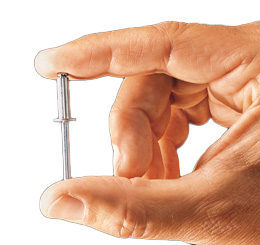
If you want to join metal, plastic or other materials permanently, blind rivets come into play. But what many people overlook is that it is not the rivet alone that determines the result. The mandrel is the actual heart of the process.
The mandrel is a sturdy metal pin. It sits inside the blind rivet and ensures that the rivet deforms during setting, creating a secure joint. Without it, the rivet remains a hollow tube with no function.
This knowledge is not only relevant to industrial businesses. You will also regularly encounter the mandrel in bodywork, electrical engineering and DIY projects.
What is the function of the mandrel?
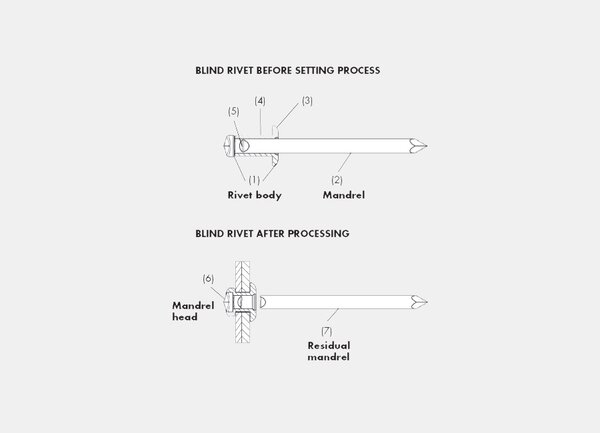
A rivet mandrel consists of three main parts. The rivet nut body is the long, slender section. It runs through the blind rivet body and protrudes from the tool side. The head is situated at the front end and has a larger diameter. It is responsible for causing the rivet to expand when pulled. The predetermined breaking point is located at the rear of the mandrel. At this predefined point, the mandrel breaks off as soon as the required tensile strength is reached.
The process for applying blind rivets takes place in three steps.
Insertion: You insert the rivet into the pre-drilled hole. The mandrel protrudes from the hand rivet tool on your side.
Pulling: The hand rivet tool grips the mandrel with its jaws and pulls it back with force. As this happens, the head of the mandrel presses against the rivet. The rivet expands at the rear and clamps the materials firmly together.
Shearing: As soon as the joint is secure, the mandrel shears off at the predetermined breaking point. The remaining mandrel stays inside the blind rivet body and seals it.
This mechanism makes blind rivets particularly practical. You only need access to the workpiece from one side.
How does the mandrel affect the quality of the joint?
The quality of the joint depends directly on the mandrel. It determines how much force is transferred to the rivet and how evenly it deforms.
The tensile strength describes how strong the joint is against forces in the longitudinal direction. The shear strength indicates how well it withstands lateral loads. A precisely manufactured mandrel with a cleanly positioned predetermined breaking point ensures that both values are reliably achieved.
Defects often arise from using the wrong mandrel. If it is too soft, it bends instead of forming the rivet. If it is too brittle, it breaks prematurely. If the predetermined breaking point is too deep or not pronounced enough, the mandrel either breaks too early or slips through. In all cases, the joint is compromised.
When purchasing, you should look out for the following quality features:
- Tolerances: A good mandrel fits exactly into the rivet without wobbling.
- Surface quality: Cracks or irregularities on the rivet nut body lead to uncontrolled breakage.
- Compliance with standards: Look for rivets and mandrels that have been tested in accordance with DIN ISO.
- Manufacturer’s specifications: Combination and size specifications should always be consistent with one another.
Which rivet mandrel should you buy for which application?
Although the mandrel is an integral part of a blind rivet, it is by no means a minor component. It is the element that determines whether a riveted joint is reliable or fails. Anyone who cuts corners when buying blind rivets and opts for cheap products risks unstable joints and extra work.
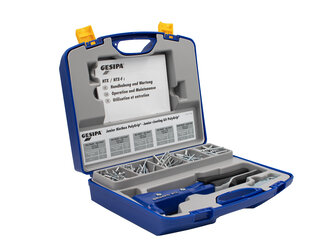
For DIY enthusiasts and occasional projects, sets available from the retailer area containing aluminium rivets and matching mandrels are perfectly adequate. A medium-sized hand rivet tool and an assortment box containing the standard sizes (3.2 mm, 4.0 mm, 4.8 mm) will cover most tasks.

For professional users and industrial applications, it is worth investing in high-quality materials made from stainless steel or coated steel. Here, precision directly translates into durability and workplace safety. Choose manufacturers who provide technical data sheets specifying tensile and shear strength values.
Conclusion
The mandrel leads an underappreciated existence. Once the job is done, it disappears into the spent mandrel container and remains invisible to the naked eye. Yet it is precisely this component that determines whether a riveted joint holds or fails.
Anyone who focuses solely on the rivet and takes the mandrel for granted runs the risk of cutting corners in the wrong place. Substandard material, incorrect dimensions or an imprecise predetermined breaking point can render even high-quality rivets ineffective.
The good news is that, with the right knowledge, making the right choice is not complicated. Ensure that the material, size and manufacturer are all compatible. Buy products that comply with standards. And store your consumables carefully.
